
EMAIL SUPPORT
dclessons@dclessons.comLOCATION
USVerifying Blade Chassis
Cisco UCS is a computing architecture that is designed for IT innovation and business acceleration. As part of the Cisco UCS portfolio, the Cisco UCS B-Series blade servers incorporate industry-standard server technologies, delivering a unified architecture-driven solution for data centers. The Cisco UCS B-Series components include: Cisco UCS Fabric interconnects, blade server chassis, and blade servers.
When the Cisco UCS is utilizes as part of the virtualization environment, such as hosting the VMware hypervisor, you should be able to troubleshoot issues related to the Cisco UCS components. This figure shows an example where Cisco UCS is connected to the Cisco ACI fabric.
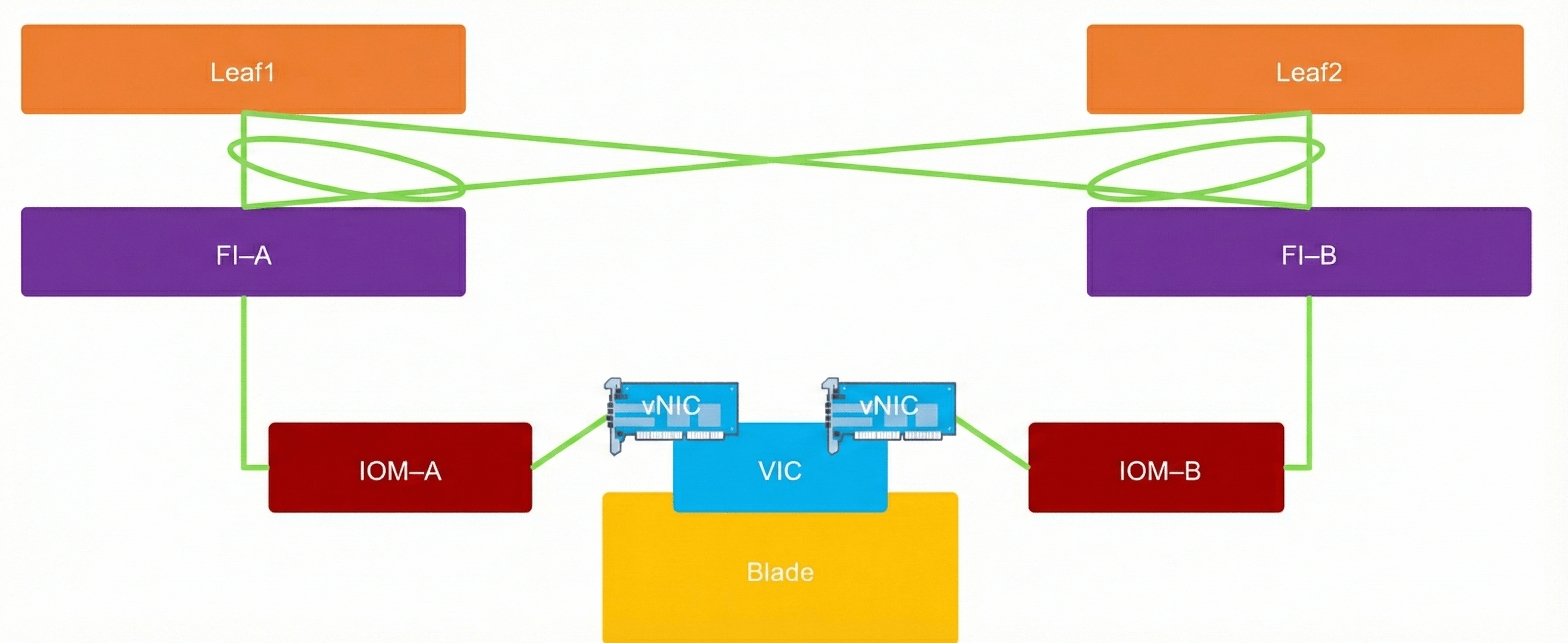
The Cisco UCS Fabric Interconnect is a core part of the Cisco UCS. The fabric interconnects provide both network connectivity and management capabilities. You primarily use it to connect Cisco UCS B-Series blade servers, but you can also use it to connect and manage Cisco UCS C-Series rack-mount servers. The chassis and servers that are connected to fabric interconnects, become part of a single and highly available management domain.
The example above utilizes a redundant pair of fabric interconnects in a cluster configuration, FI-A and FI-B, for high availability, connected to the chassis I/O modules (IOMs). If one fabric interconnect becomes unavailable, the other takes over, since the cluster configuration actively enhances failover recovery time for redundant virtual interface connections.
The Cisco UCS Manager is the management system for all components in the Cisco UCS, which runs within the fabric interconnect. Cisco UCS Manager participates in server provisioning, device discovery, inventory, configuration, diagnostics, monitoring, fault detection, auditing, and statistics collection.
Videos

Comment
TABLE OF CONTENTS
RECENT POSTS
- Exploring Cisco ISE Authorization Policy Elements
- Understanding Cisco ISE Authentication and Authorization Policies
- Installing Context-Aware Network Access Control using Cisco ISE Policies
- Designing Network Access Control that is Scalable using Cisco ISE Architecture
- Enterprise Network Access Control and Policy Enforcement using Cisco ISE
- Secure Device Administration and Network Access Using AAA Architecture
- Designing Enterprise-Class Hybrid Cloud Connectivity Using AWS Networking Services
- Exploring Core AWS Networking and Messaging Concepts for Modern Cloud Architectures
- Understanding Key AWS Services for Modern Cloud Architectures
- Building a Strong AWS Foundation with Amazon S3, EC2, and Virtual Private Cloud



LEAVE A COMMENT
Please login here to comment.