
EMAIL SUPPORT
dclessons@dclessons.comLOCATION
USUnderstanding Cisco ISE Authentication and Authorization Policies
Introduction
Modern enterprise networks can accommodate an array of devices, users, and applications. Visitors, contractors, employees, and IoT devices usually need different access levels to the network's resources. As organizations continue to grow the digital network infrastructure they have, managing who can access their network and which resources they can access is becoming more important.
Cisco Identity Services Engine (ISE) offers a central platform for access to networks based on identity control. With authentication as well as authorization policies, Cisco ISE helps organizations verify identities, enforce access rules, and maintain a consistent security level across wireless, wired, and remote access environments.
The authentication and authorization policies are the heart of Cisco ISE's policy framework. These policies decide if a user or device is allowed to connect to the network and the type of permissions they must be granted following successful authentication.
In this blog, we'll examine the way Cisco's ISE Authentication as well as Authorization Policies functions, learn about the importance of the Policy Sets, look at the authentication process of RADIUS, and provide the best practices to build reliable and secure access control systems.
What Are Authentication and Authorization Policies in Cisco ISE?
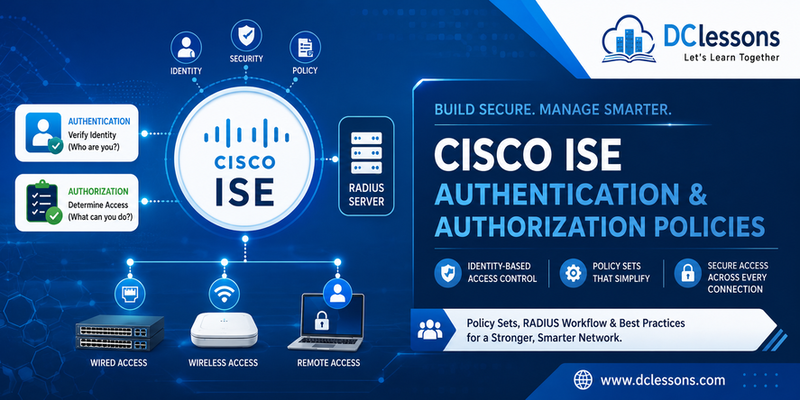
Authorization and authentication are two of the most important elements that are essential to Cisco ISE network access control.
Authentication is the method of confirming the identity of the user or device trying to connect to the network. Before granting access, Cisco ISE validates credentials like passwords, usernames, certificates, or MAC addresses.
Authorization is the process that occurs following successful authentication. This is when Cisco ISE determines what resources and services the authenticated user device has access to.
For instance, two people could successfully authenticate to the network, but their authorization results could differ. A worker may have access to business applications within the company; however, a guest could be granted access only to the internet.
By combining authorization and authentication, Cisco ISE ensures that access decisions are dependent on security and identity requirements and policies of the organization.
Understanding Cisco ISE Policy Sets
Policy sets are the core for Cisco Access Control for ISE.
A policy set is a set of authentication policies and authorization policies that work in conjunction to handle requests for access to networks. The policy sets are developed to meet the needs of a specific access situation and user group.
Organizations typically make policy sets that are designed for:
Wired corporate users
Wireless users
Guest users
Contractors
IoT devices
Printers as well as non-802.1X endpoints
This systematic approach makes it easier to manage the management of policies while increasing security and scalability.
How Policy Sets Process Requests
When Cisco ISE receives a RADIUS request, it performs an established evaluation procedure.
Cisco ISE identifies the matching policy set.
Policies on authentication are analyzed.
Identity of the user or device is confirmed.
Authorization policies are reviewed.
The final decision on access is then returned to the device that is connected.
This workflow makes sure that each access request is dealt with promptly and in line with the company's guidelines.
How Cisco ISE Authentication Policies Work
The authentication policy is accountable for verifying the identity of the device and user before granting access to networks.
Typically, an authentication rule consists of three main elements:
Conditions
Allowed Protocols
Identity Stores
Authentication policies typically are based on this principle:
IF Conditions Match - Allow Protocol - Check Identity Store
If, for instance, an endpoint is found to be in the Wired MAB circumstance, Cisco ISE may allow MAC authentication bypass and verify the endpoint against a local endpoint database.
Authentication policies serve as the initial protection by ensuring that only authentic users and devices are able to go further through the process of access control.
Key Goals of Authentication Policies
Authentication policies can help companies achieve many important goals.
Validate User and Device Credentials
Cisco ISE verifies whether credentials are authentic before allowing access.
Block Unauthorized Access Requests
If authentication fails, requests are refused access to the network.
Route Requests to the Correct Identity Store
Cisco ISE can validate identities by using a variety of identity sources, such as
Microsoft Active Directory
LDAP Directories
Internal Users Database
Internal Endpoints Database
Certificate-Based Authentication Systems
Pass Successful Requests to Authorization
If authentication succeeds, Cisco ISE forwards the request to authorization processing.
Understanding Authentication Rule Evaluation
Authentication rules within Cisco ISE are analyzed from top to bottom.
If a match rule is identified, the policy evaluation ceases, and the appropriate action is implemented. This is referred to as "the second-match model of evaluation."
For instance:
Rule 1: Wired MAB Devices
Rule 2: Wireless Corporate Users
Rule 3: Guest Users
If a request complies with rule 1, Cisco ISE does not proceed to evaluate the other rules.
Due to this, the rule of law is crucial.
Best Practices for Rule Evaluation
Put rules frequently used in conjunction with each other close to the top.
Use descriptive and clear rule names.
Different policies based on access methods.
Examine rules frequently to avoid unnecessary complications.
A well-organized rule structure improves efficiency and makes troubleshooting easier.
Cisco ISE RADIUS Authentication Process Explained
RADIUS is the most widely used protocol for communicating with Cisco ISE and network access devices, such as switches, wireless controllers, and VPN gateways.
If a device or user is trying to join, the device forwards an authentication request to Cisco ISE through RADIUS.
The procedure typically involves these steps:
Step 1: User or Device Requests Access
An endpoint establishes a connection via the network.
Step 2: Network Device Sends RADIUS Request
The wireless controller, or switch, transmits the message through Cisco ISE.
Step 3: Cisco ISE Selects a Policy Set
Cisco ISE evaluates conditions and determines the suitable policy set.
Step 4: Authentication Policies Are Evaluated
Credentials are checked against the identity source configured.
Step 5: Authorization Policies Are Evaluated
Access permissions are established.
Step 6: Access Decision Is Returned
Cisco ISE sends the authorization result to the device on the network.
This method allows central access control while ensuring consistent security monitoring throughout the entire network.
Wired MAB and Wireless MAB Authentication in Cisco ISE
Some devices do not support 802.1X authentication. Printers or IP telephones, cameras for surveillance, and industrial equipment usually require different authentication methods.
Cisco ISE supports these devices via MAC authentication bypass (MAB).
Wired MAB Authentication
In a wired setting, switches send the device's MAC address to Cisco ISE. This MAC address is verified against the endpoint databases that are configured for policies.
If the device is identified, it is recognized, and access rights are granted.
Wireless MAB Authentication
Wireless MAB operates similarly; however, it is applied to wireless devices that don't use traditional authentication methods.
MAB allows organizations to safely integrate existing as well as IoT devices while ensuring the visibility of access control.
Smart Conditions in Cisco ISE
Cisco ISE includes predefined Smart Conditions that help in the creation of policies.
Examples include:
Wired_MAB
Wireless_MAB
These scenarios employ predefined logic to determine specific authentication requests.
For Cisco devices, Smart Conditions typically look at RADIUS attributes like
NAS-Port-Type
Service Type
Call Check
These features aid Cisco ISE in accurately classifying access requests and determining the appropriate policies for authentication.
How Cisco ISE Authorization Policies Work
Once authentication is successful, Cisco ISE evaluates authorization policies.
Authorization is the process that determines which network resources, services, and other network features an authenticated device or user has access to.
Authorization decisions may include:
VLAN Assignment
Users are able to be assigned to particular VLANs according to roles or security needs.
Downloadable Access Control Lists (dACLs)
Cisco ISE can apply downloadable ACLs to manage traffic flow.
Security Group Tags (SGTs)
Companies that use Cisco TrustSec may benefit from Security Group Tags for scalable policy enforcement.
Guest Access
Guest users may be restricted to internet access only.
Restricted Access
Devices that are not compliant can be directed to remediation networks or assigned restricted access rights.
Authorization policies allow the flexibility required to ensure that security controls are driven by business.
Authentication vs. Authorization in Cisco ISE
The two are inextricably linked, as they have different functions inside the Cisco ISE access control framework.
Authentication can be credited with confirming the identity of a person or device that is trying to connect to the network. Cisco ISE validates credentials such as passwords and usernames, digital certificates, and MAC addresses prior to allowing the connection to proceed.
Authorization takes place after successful authentication. After Cisco ISE confirms the identity of the device or user and determines what resources and services or network segments are accessible according to the policies of the organization.
In simple terms:
Authentication is a way to answer the question, "Who are you?"
Authorization answers the question, "What are you allowed to access?"
Think about a worker from a corporate company connected to the company's wireless network. Cisco ISE first authenticates the user with Active Directory to confirm their identity. After authentication is successful, authorization policies decide if the employee will be granted access to applications within the company or file servers, administrative resources, or even restricted network segments.
This double-step method makes sure that users are not only verified but also get the right amount of access according to their roles and requirements.
Best Practices for Cisco ISE Policy Design
An effective policy formulation is vital to ensure security and the ability to scale.
Organize Policy Sets by Use Case
Create separate policy sets to:
Wired users
Wireless users
Access for guests
Contractors
IoT devices
Use Smart Conditions
Reusable smart conditions make administration easier and enhance coherence.
Optimize Rule Order
Put rules that are commonly matched on top of the list of policies.
Use Consistent Naming Conventions
Name-specific standards for clear naming improve the process of troubleshooting and reporting.
Review Policies Regularly
As the needs of business evolve, access control policies need to be reviewed and revised.
Organizations that are implementing Cisco ISE at scale often benefit from a well-organized policy framework.
Common Authentication and Authorization Issues
Even the most well-designed Cisco ISE deployments could face difficulties.
Authentication Problems
Common issues are
Incorrect user credentials
Active Directory connectivity failures
Certificate validation errors
Methods for authentication that aren't supported
Authorization Problems
Common causes are
Incorrect rule order
Profiles for authorization that are not present
Policy Set mismatches
VLAN assignment problems
Improper dACL configurations
Monitoring and validation of policies regularly can quickly pinpoint and address these issues.
Conclusion
Cisco ISE Authentication and Authorization Policies are the basis of security-based network access control. Authentication is a way to verify the identities of users as well as gadgets, while authorization decides the services and resources they can access. Together, these policies assist organizations in enforcing security, increasing visibility, and streamlining access management across wireless, wired, and remote access environments.
By using policy sets and RADIUS-based authentication smart conditions and the ability to authorize dynamically, businesses can build accessible access control systems that can adapt to evolving business needs.
For professionals in the field of networking looking to gain experience in Cisco IOS, Dclessons offers comprehensive Cisco ISE courses, interactive demonstrations, and realistic deployment scenarios. Understanding the authentication policies and authorization policies, as well as RADIUS workflows, is vital to designing and managing a safe enterprise network.
Frequently Asked Questions (FAQs)
What is the goal of the authentication policies in Cisco ISE?
Authentication policies confirm the identity of users as well as devices that attempt to access the network. They verify credentials, choose identity stores, and ensure that only authorized users go through an authorization stage.
What are authorization policies? How do they function inside Cisco ISE?
Authorization policies are analyzed following successful authentication. They determine which resources, such as VLANs, ACLs, or permissions, must be given to the user or device.
What is a policy set in Cisco ISE?
A policy set is a set of authorization and authentication rules utilized by Cisco ISE to process network access requests. It aids administrators in organizing policies for various access scenarios.
What is MAC Authentication Bypass (MAB) in Cisco ISE?
MAB is an authentication technique employed for devices that don't allow 802.1X authentication. Cisco ISE validates the device's MAC address and then applies the appropriate authorization policies.
What is the significance of RADIUS to Cisco ISE deployments?
RADIUS allows the communication between devices on networks and Cisco ISE. It handles authorization and authentication requests, which allows Cisco ISE to make centralized access control decisions across the network.
You might also find these blog posts interesting:
Installing Context-Aware Network Access Control using Cisco ISE Policies
Designing Network Access Control that is Scalable Using Cisco ISE Architecture
Enterprise Network Access Control and Policy Enforcement using Cisco ISE
Comment
RECENT POSTS
- Understanding Cisco ISE Authentication and Authorization Policies
- Installing Context-Aware Network Access Control using Cisco ISE Policies
- Designing Network Access Control that is Scalable using Cisco ISE Architecture
- Enterprise Network Access Control and Policy Enforcement using Cisco ISE
- Secure Device Administration and Network Access Using AAA Architecture
- Designing Enterprise-Class Hybrid Cloud Connectivity Using AWS Networking Services
- Exploring Core AWS Networking and Messaging Concepts for Modern Cloud Architectures
- Understanding Key AWS Services for Modern Cloud Architectures
- Building a Strong AWS Foundation with Amazon S3, EC2, and Virtual Private Cloud
- Understanding the ENSDWI Course: Advanced Cisco SD-WAN (Viptela) Concepts



LEAVE A COMMENT
Please login here to comment.