
EMAIL SUPPORT
dclessons@dclessons.comLOCATION
USInstalling Context-Aware Network Access Control using Cisco ISE Policies
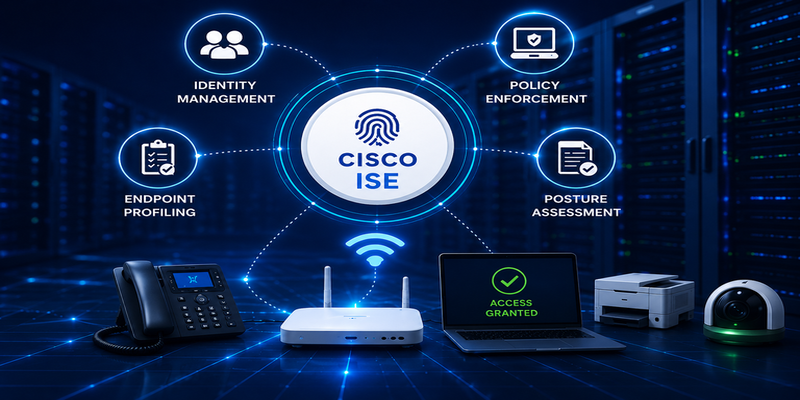
Modern enterprise networks aren't static systems where simple authentication is sufficient. Businesses now require sophisticated, contextually aware access control that can continuously evaluate users' devices, their capabilities, and security practices prior to giving access. This has led to Network Access Control (NAC), an essential element of any security system.
Utilizing Cisco ISTE (Identity Services Engine), it is possible for enterprises to design and enforce sophisticated NAC rules that extend far beyond basic authentication. Through the combination of multiple policies, Cisco ISE enables an integrated approach to protect wireless, wired, or remote access networks.
In this blog, we'll examine how to configure Cisco ISE to build NAC policy, learn about the key ISE NACP parts, and then look at the policy enforcement process in real-world settings by using the learning method taken from DClessons.
Introduction to Network Access Policy in Modern Enterprises
Today's enterprises are operating in extremely dynamic settings, where users are connected across multiple locations with a variety of devices. Traditional security strategies fail to tackle:
Diversity of devices (laptops, IoT, mobiles)
Work from home and in a hybrid environment
Security conformity standards
To overcome these issues and address these challenges, companies adopt contextually-aware NAC solutions that assess:
User identity
Type of device
Security posture
Access method and location
Cisco ISE provides this capability via its Network Access Control Policy (NACP) framework.
Overview of Cisco ISE NACP
The ISE NACP (Network Access Control Policy) is a well-organized mix of several policies that work in concert to ensure secure and flexible access control.
Instead of relying on one rule, Cisco ISE evaluates multiple layers of policies to decide:
The question is whether access is appropriate to be granted
What kind of access is allowed?
What security limitations should be enforced?
This layering approach ensures the access decision is based on context and adaptable, thereby improving overall security of the network.
Core Cisco ISE NACP Components
Cisco ISE NACP consists of various policy components that together ensure access control:
- Authentication Policy
This policy validates the identity of any users or devices trying to connect to the network. It allows:
Enterprise users
Access for guests
Device-based authentication
- Authorization Policy
After authentication
This policy will determine the authorized actions that are allowed. For instance:
Assign VLANs
Apply ACLs
Restrict or allow certain services
Authorization policies are only enforced when a rule matches.
- Device Profiling Policy
This policy is able to identify the type of device connected to the internet. It is passive and assists in:
Detecting devices that are not recognized
Enforcing device-specific access control
Enhancing visibility
- Host Security Posture Assessment Policy
This policy assesses the security capabilities of the device, which includes:
Status of the antivirus
OS updates
Configuration of the firewall
In accordance with the law on compliance, access may be allowed or restricted, or even denied.
Configuring Cisco ISE to Build NAC Policy
To enable the ISE to create NAC policies, administrators utilize the ISE GUI that provides a centralized interface to manage all policies.
Typical Workflow:
Define authentication sources (e.g., AD, LDAP).
Configure authentication policies
Create authorization rules
Make sure you enable profiling and posture policies.
Test and verify the behavior of the policy
The ISE GUI makes it easier to create policies creating by permitting administrators to design rules-based logic using specific conditions or actions.
Authentication Mechanisms and MAB in ISE
Cisco ISE supports multiple authentication methods, which ensure compatibility with different types of devices.
MAC Authentication Bypass (MAB)
MAC Authentication Bypass (MAB) is utilized when devices are not able to allow 802.1X authentication, like:
Printers
IP phones
IoT devices
In MAB:
A device's MAC number is utilized to determine its identification
ISE examines its MAC with its databases
Access to information is granted or denied according to the policy
MAB is typically utilized together with 802.1X to provide a broad coverage of the network.
Policy Enforcement Phases in ISE Deployment
The deployment of NAC policies on an active network requires a gradual method to prevent disruptions.
Common Policy Enforcement Phases:
- Monitor Mode
No enforcement
Only the ability to see devices and users
- Low Impact Mode
Enforcement is limited
Policy testing is gradual
- Closed Mode
Full enforcement
Only authorized users or devices gain access.
This deployment phase helps companies to reduce the risk of installing an ISE solution.
Security Domains in Cisco ISE
Security domains organize users and devices on the basis of similar risks and access conditions.
Examples:
Guest Access
Wired Network Users
Wireless Users
Remote Access
Internet Access
When they define security domains, companies can implement the same scalable policy across various networks.
Understanding ISE Authorization Rules
Authorization rules form the basis of the policy enforcement system within Cisco ISE.
Key Characteristics:
From top to bottom
The first rule of matching is used.
Decides on the final access control decision
Common Actions in Authorization Rules:
Access to the Internet is permitted or denied
Assign VLAN or ACL
Apply TrustSec SGT
Redirect to the web for authentication
Inforce checks on posture
These rules permit precise control over access to networks.
Host Security Posture Assessment in ISE
Posture assessment makes sure that only compliant and secure devices are granted network access.
Types of Posture Agents:
Temporary Agent
Installed using a browser
Limited functional
No remediation capability
Full Agent (Cisco AnyConnect)
Attached to the point of termination
Performs extensive security checks
Aids in remediation actions
Remediation Examples:
Update your antivirus
Applying OS patches
Ensuring firewall rules are enforced
All posture configurations are controlled via the ISE GUI. This makes it simpler to apply compliance guidelines.
Deploying Cisco ISE Solution in Enterprise
When installing an ISE solution, companies must be aware of:
Definition of clear security objectives
Ensure that devices are visible to the fullest extent
Integration with MDM systems
Implementing the phased deployment
Key Objectives:
Verify all devices and users
Enforce proper authorization
Corporate traffic and segment guest traffic
Find and quarantine the devices that are infected
A well-planned deployment will provide solid security with little disruption.
Benefits of Context-Aware NAC Using Cisco ISE
Cisco ISE provides multiple benefits for enterprises' networks:
Centralized policy enforcement
Increased visibility (Who is, Which, When)
Dynamic access control
Improved security compliance
Integration with other systems
It transforms conventional security networks into adaptive and intelligent security environments.
Final Thoughts
The creation of a strong Network Access Control Policy (NACP) in Cisco ISE is essential for protecting the modern-day enterprise network. Through the combination of authorization, authentication profiling, and posture analysis, Cisco ISE enables a fully contextual Access Control System.
A method of deployment that is phased in conjunction with the appropriate use of MAC authentication bypass (MAB) and clearly defined authorization rules will ensure that businesses can implement NAC without operational risk.
Through the practical lessons of DClessons, professionals learn from real-world experience when it comes to creating, configuring, and installing Cisco ISE policies that align with the security needs of enterprises.
Frequently Asked Questions (FAQs)
What are the primary elements of Cisco NACP ISE?
Cisco ISE NACP comprises authentication Policy as well as authorization Policy and Device Profiling Policy, along with Host Security Assessment Policy. These components are used together to ensure that access control is context-aware.
What exactly is MAC Authentication Bypass (MAB), and how do you use it?
MAB is a device that does not have 802.1X authentication. It relies on its MAC address to identify it and is typically used for printers, IP phones, and IoT devices.
What are the various phases of policy enforcement within Cisco ISE?
Cisco ISE supports Monitor Mode, Low Impact Mode, and Closed Mode. These modes allow for the gradual introduction of NAC policies without affecting the network.
What is the process for authorization rules inside Cisco ISE?
Authorization rules are analyzed from top to bottom. If a rule is found to be compatible, ISE applies the defined action, like the granting of access, granting VLANs, or implementing security policies.
What's the point of assessing host posture in ISE?
Host posture assessment determines whether a device complies with security requirements, such as security features like antivirus software, OS updates, and firewall settings. Unconforming devices may be denied access or remedied prior to access being granted.
You might also find these blog posts interesting:
Designing Network Access Control that is Scalable using Cisco ISE Architecture
Enterprise Network Access Control and Policy Enforcement using Cisco ISE
Secure Device Administration and Network Access Using AAA Architecture
Comment
RECENT POSTS
- Exploring Cisco ISE Authorization Policy Elements
- Understanding Cisco ISE Authentication and Authorization Policies
- Installing Context-Aware Network Access Control using Cisco ISE Policies
- Designing Network Access Control that is Scalable using Cisco ISE Architecture
- Enterprise Network Access Control and Policy Enforcement using Cisco ISE
- Secure Device Administration and Network Access Using AAA Architecture
- Designing Enterprise-Class Hybrid Cloud Connectivity Using AWS Networking Services
- Exploring Core AWS Networking and Messaging Concepts for Modern Cloud Architectures
- Understanding Key AWS Services for Modern Cloud Architectures
- Building a Strong AWS Foundation with Amazon S3, EC2, and Virtual Private Cloud



LEAVE A COMMENT
Please login here to comment.