
EMAIL SUPPORT
dclessons@dclessons.comLOCATION
USSD-WAN VeloCloud Network Migration
In this topic we will see how a traditional WAN is transformed to SD-WAN , what are all step by step procedure that is to be used for SD-WAN network Migration. Let see how the topology looks like before SD-WAN migration.
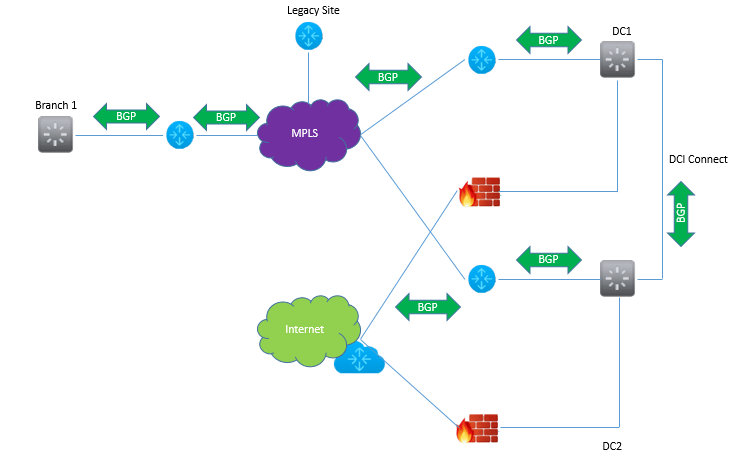
In this above topology, Branch 1 is connected to MPLS and one legacy site is also connected to MPLS. Two DC which are also connected to MPLS and Internet and also to each other via DCI link.
- Two identical active/standby DCs with DCI
- Branch 1 will eventually replace CE with SD-WAN but no change to MPLS circuit
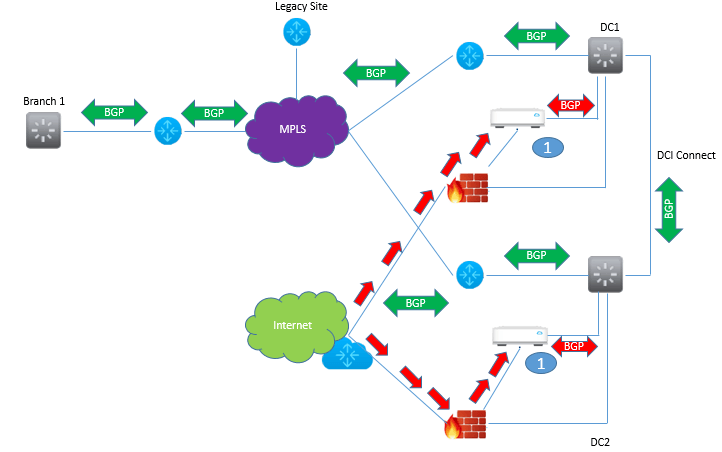
Step 1: Add HUB VCE and activate in DC1 & DC2
- Activate the hub VCE and enable BGP with the L3 switch, by doing this this HUB will be managed by Orchestrator and will peer with Global gateway for Control plane. It will build the tunnel with gateway and start running BGP with L3 switch in DC.
- Best practice: When you start, filter the BGP routes from SD-WAN toward your network, so that you start learning any prefixes but do not inject in DC network until all SD-WAN is ready.
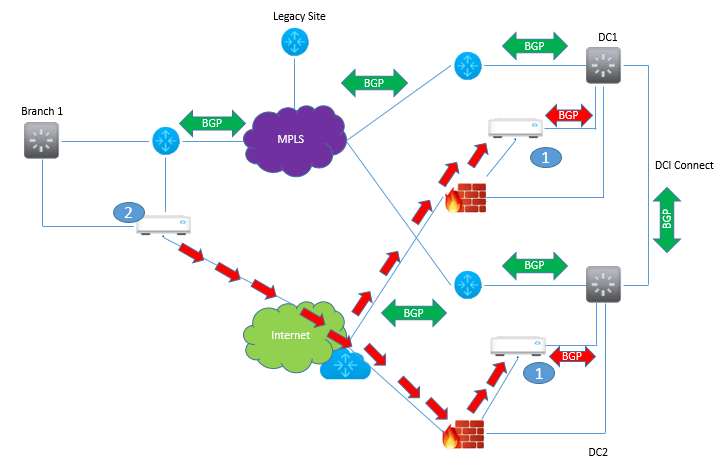
Step 2: Add Branch VCE and Activate
Activate the branch VCE and enable BGP with L3 switch, by doing so Branch VCE will form the SD-WAN overlay tunnel to DC1 and DC2 HUB VCE via internet link
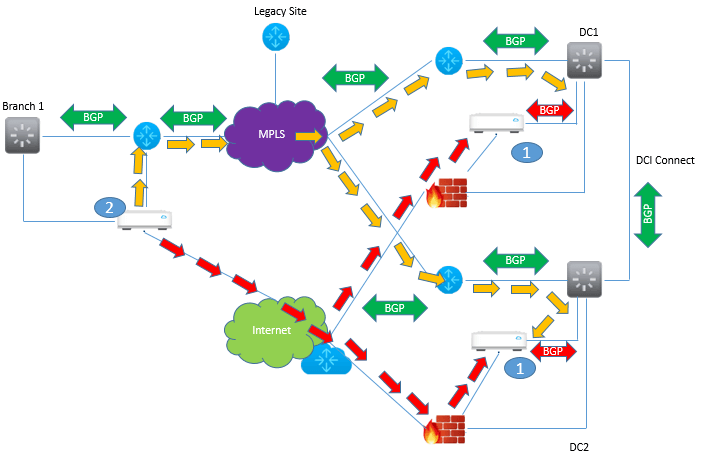
Step 3: Building the overlay tunnel and enable routing at branch

Comment
-
GA
This is a very detailed course on sd wan velocloud network migration. It will help you provide develop knowledge, skills, and abilities to deploy VMware SD-WAN with the help of VeloCloud. They have covered a step-by-step procedure that is to be used for SD-WAN network Migration. This has helped me gain a lot of knowledge.
-
OL
This is a very important course for those in the network operations team with SD-WAN solutions. They have covered everything needed to build an SD-WAN environment. I have gained a lot from this course. My boss has considered promoting my designation. Thanks to the DC lesson and this amazing course.
TABLE OF CONTENTS
RECENT POSTS
- Exploring Cisco ISE Authorization Policy Elements
- Understanding Cisco ISE Authentication and Authorization Policies
- Installing Context-Aware Network Access Control using Cisco ISE Policies
- Designing Network Access Control that is Scalable using Cisco ISE Architecture
- Enterprise Network Access Control and Policy Enforcement using Cisco ISE
- Secure Device Administration and Network Access Using AAA Architecture
- Designing Enterprise-Class Hybrid Cloud Connectivity Using AWS Networking Services
- Exploring Core AWS Networking and Messaging Concepts for Modern Cloud Architectures
- Understanding Key AWS Services for Modern Cloud Architectures
- Building a Strong AWS Foundation with Amazon S3, EC2, and Virtual Private Cloud



LEAVE A COMMENT
Please login here to comment.