
EMAIL SUPPORT
dclessons@dclessons.comLOCATION
USBGP-EVPN LAB-Scenerio 1
This is the best VXLAN LAB related to BGP-EVPN configuration in VXLAN.
Scenerio:
Configure the VXLAN EVPN in such a way that host can be able to reach to each other.
Topology:
Use the below topology for configuration.
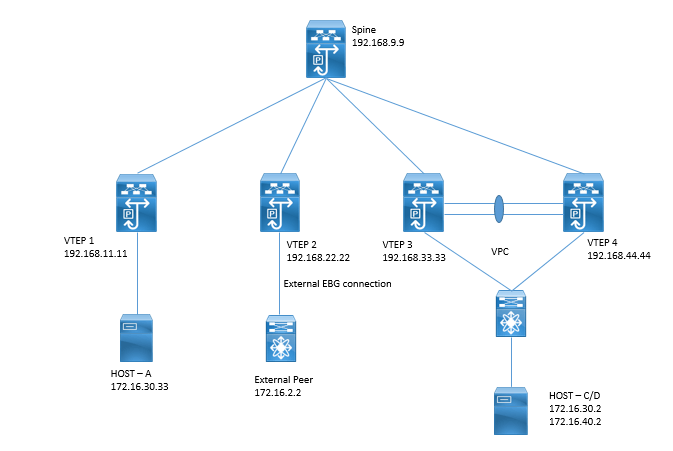
VTEP 1 Configuration:
VTEP1
!
Enabling features
nv overlay evpn
feature ospf
feature bgp
feature pim
feature interface-vlan
feature vn-segment-vlan-based
feature lacp
feature vpc
feature nv overlay
!
fabric forwarding anycast-gateway-mac 0001.0001.0001 <-- This is needed for seamless VM mobility across VTEPS
ip pim rp-address 192.168.9.9 group-list 224.0.0.0/4 <-- SPINE is the RP.
!
ip pim ssm range 232.0.0.0/8
!
vlan 1,10,30,40,100,200
!
vlan 10
name L3-VNI-VLAN-10
vn-segment 10000010
vlan 30
vn-segment 10000030
!
vrf context EVPN-L3-VNI-VLAN-10 <-- Defining layer3 vrf for Inter-VNI traffic.
vni 10000010
rd auto
address-family ipv4 unicast
route-target both auto
route-target both auto evpn
!
interface Vlan10 <-- Layer3 VNI associated interface vlan does not have an ip address.
no shutdown
vrf member EVPN-L3-VNI-VLAN-10
ip forward
!
interface Vlan30 <-- Associating the Host A Vlan with layer3 vrf.
no shutdown
vrf member EVPN-L3-VNI-VLAN-10
ip address 172.16.30.1/24
fabric forwarding mode anycast-gateway
!
interface nve1 <-- Nve is logical interface where VXLAN packets are encapsulated and decapsulated.
no shutdown
source-interface loopback2
host-reachability protocol bgp <-- This means BGP control plane is used to exchange updates.
member vni 10000010 associate-vrf <-- associate-vrf is used for for layer3 vni.
member vni 10000030
suppress-arp
mcast-group 239.1.1.10 <--This is used for controlled flooding of arp requests.
!
interface Ethernet1/2 <-- Ospf with PIM is used as Underlay.
description "Going to Spine"
no switchport
ip address 192.168.19.1/24
ip router ospf UNDERLAY area 0.0.0.0
ip pim sparse-mode
no shutdown
!
interface Ethernet1/11 <-- Port to Host A.
switchport mode trunk
!
interface loopback2 <-- Loopback for BGP Peering.
description "Loopback for "BGP"
ip address 192.168.11.11/32
ip router ospf UNDERLAY area 0.0.0.0
ip pim sparse-mode
!
router ospf UNDERLAY
!
router bgp 65000
address-family ipv4 unicast
address-family l2vpn evpn
neighbor 192.168.9.9
remote-as 65000
update-source loopback2
address-family ipv4 unicast
address-family l2vpn evpn
send-community extended
vrf EVPN-L3-VNI-VLAN-10
address-family ipv4 unicast
advertise l2vpn evpn
!
evpn
vni 10000030 l2
rd auto <-- RD is default calculated as VNI:BGP Router ID
route-target import auto <-- RT is default calculated as BGP AS:VNI
route-target export auto
VTEP 2 Configuration :
VTEP2
!
nv overlay evpn
feature ospf
feature bgp
feature pim
feature interface-vlan
feature vn-segment-vlan-based
feature lacp
feature vpc
feature nv overlay
!
fabric forwarding anycast-gateway-mac 0001.0001.0001
!
ip pim rp-address 192.168.9.9 group-list 224.0.0.0/4
!
ip pim ssm range 232.0.0.0/8
vlan 1,10,30,40,100
!
vlan 10
name L3-VNI-VLAN-10
vn-segment 10000010
!
vrf context EVPN-L3-VNI-VLAN-10 <-- Defining layer3 vrf for Inter-VNI traffic.
vni 10000010
rd auto
address-family ipv4 unicast
route-target both auto
route-target both auto evpn
!
interface Vlan10 <-- Layer3 VNI associated interface vlan does not have an ip address.
no shutdown
vrf member EVPN-L3-VNI-VLAN-10
ip forward
!
interface Vlan100 <-- This vlan is used to peer with external EBGP Peer.
no shutdown
vrf member EVPN-L3-VNI-VLAN-10
ip address 192.168.1.2/24
!
interface nve1
no shutdown
source-interface loopback2
host-reachability protocol bgp
member vni 10000010 associate-vrf
!
interface Ethernet1/2 <-- Ospf and PIM are used in Underlay.
description "Going to Spine"
no switchport
ip address 192.168.29.2/24
ip router ospf UNDERLAY area 0.0.0.0
ip pim sparse-mode
no shutdown
!
interface Ethernet1/12 <-- Port to External Peer.
switchport mode trunk
!
interface loopback2
ip address 192.168.22.22/32
ip router ospf UNDERLAY area 0.0.0.0
ip pim sparse-mode
!
router ospf UNDERLAY
!
router bgp 65000
address-family ipv4 unicast
address-family l2vpn evpn
neighbor 192.168.9.9 <-- Peering with SPINE.
remote-as 65000
update-source loopback2
address-family ipv4 unicast
address-family l2vpn evpn
send-community extended
vrf EVPN-L3-VNI-VLAN-10
address-family ipv4 unicast
advertise l2vpn evpn
neighbor 192.168.1.1 <-- Peering with External Peer, under vrf.
remote-as 65111
update-source Vlan100
address-family ipv4 unicast
VTEP 3 Configuration

Comment
-
-
AN
VTEP4 is there any VPC configuration missing such as vpc domain 2 peer-keepalive destination X.X.X.X source Y.Y.Y.Y
-
DC
Thanks for highlighting , we have added the configuration
- dclessons1
- May 21, 2022
-
TABLE OF CONTENTS
RECENT POSTS
- Exploring Cisco ISE Authorization Policy Elements
- Understanding Cisco ISE Authentication and Authorization Policies
- Installing Context-Aware Network Access Control using Cisco ISE Policies
- Designing Network Access Control that is Scalable using Cisco ISE Architecture
- Enterprise Network Access Control and Policy Enforcement using Cisco ISE
- Secure Device Administration and Network Access Using AAA Architecture
- Designing Enterprise-Class Hybrid Cloud Connectivity Using AWS Networking Services
- Exploring Core AWS Networking and Messaging Concepts for Modern Cloud Architectures
- Understanding Key AWS Services for Modern Cloud Architectures
- Building a Strong AWS Foundation with Amazon S3, EC2, and Virtual Private Cloud



LEAVE A COMMENT
Please login here to comment.