
EMAIL SUPPORT
dclessons@dclessons.comLOCATION
USUnderstanding Key AWS Services for Modern Cloud Architectures
Introduction
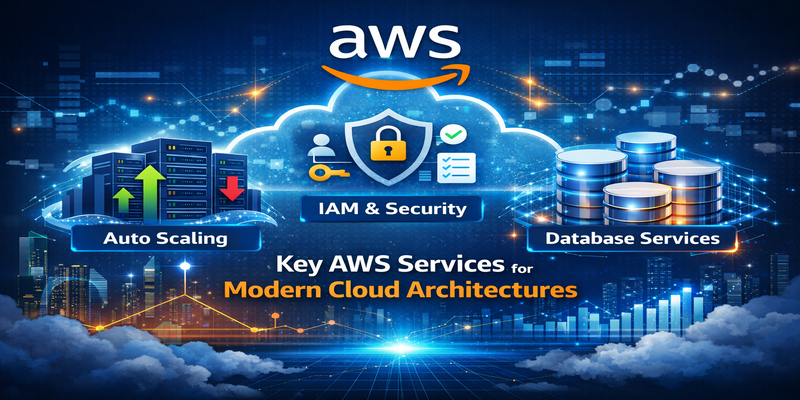
Modern cloud-based systems are expected to manage the fluctuating demand for data, implement strict security standards, and handle large amounts of data effectively. Amazon Web Services (AWS) provides a broad range of services that allow companies to create systems that can be scalable and secure as well and robust. Of these, Auto Scaling, AWS Identity and Access Management (IAM), as well as Amazon AWS Database services, play an essential role in ensuring that applications run smoothly, security governance, and management of data.
For professionals working in the field of cloud and networking to understand the way these services work and how they interact is vital. Auto Scaling guarantees optimal computing capacity. IAM regulates access and permissions, and AWS database services can handle both unstructured and structured data-intensive workloads. This blog will explain these essential AWS services in depth and describe how they provide cloud services for enterprises.
Auto Scaling in AWS: Ensuring Performance and Availability
What Is Auto Scaling in AWS?
The Auto Scaling feature in AWS is a service that was designed to automatically adjust the capacity of Amazon EC2 in accordance with predefined conditions. In place of manually adjusting resources or increasing them, Auto Scaling responds dynamically to fluctuations in demand. When the demand increases, it creates more instances. When demand falls, it shuts down unnecessary instances.
This method of automation helps companies keep their applications running smoothly while reducing expenses. An automated scale on Amazon EC2 is particularly valuable in applications that experience irregular and seasonal loads.
Auto Scaling Group AWS and Its Role
Auto scaling groups AWS can be described as a clustering of EC2 instances with similar characteristics, including the type of instance as well as launch settings. The group sets minimum, maximum, and desired capacities, and ensures that the right number of instances are running.
Auto Scaling groups continuously monitor the health of their instances. If an instance is unhealthy, it is replaced by it is replaced by the Auto Scaling process automatically replaces it, ensuring high availability, without any manual intervention.
Auto Scaling Plans Explained
Many auto scaling strategies define how the scaling action is performed:
Maintain Current Instance Levels
This program ensures that a set number of instances will be running. Auto Scaling performs periodic health checks and replaces instances that are unhealthy automatically.
Manual Scaling
Administrators adjust the minimum, maximum, as well as the desired capacity. Auto Scaling then handles instance and termination in accordance with the latest configuration.
Scheduled Scaling
This method is ideal to handle predictable workloads like reports for the month or seasonal spikes in traffic. It is possible to scale in or out at specific time intervals.
Dynamic Scaling
Dynamic scaling adapts capacity in real-time based on measurements like the utilization of CPUs as well as network usage. These metrics are tracked by Amazon CloudWatch, enabling responsive scaling choices.
The Auto Scaling Process
Automated scaling includes constant monitoring, evaluating scaling policies, and the automated processing of actions to scale. This helps ensure that applications are flexible while reducing operational overhead.
AWS Identity and Access Management: Securing Cloud Resources
AWS IAM Introduction
AWS Identity and Access Management is the AWS service responsible for controlling who has access to AWS resources and what actions they can take. A thorough AWS IAM introduction begins with knowing about groups, users, roles, and policies. IAM allows companies to apply this principle, which is called least privilege. This ensures users and services only have the rights they need.
Principals in AWS IAM
For AWS Identity and Access Management (IAM), the term "principal" is a person or entity that interacts directly with AWS resources. Principals may be permanent or temporary, and can comprise root users, IAM customers, as well as roles.
The AWS root user has unlimited access to all AWS resources. It is only used to perform essential account-level functions.
IAM Users and Roles
AWS IAM user is an AWS IAM user is a person who has been created with an identity to perform specific tasks. They are usually assigned to groups that define their authority.
Roles, on the other hand, are created to allow temporary access. If a role is taken on, AWS provides temporary security credentials via the Security Token Service (STS). This improves security by removing the requirement for long-term certificates.
Managing Access Securely
AWS IAM could be set up through the AWS Management Console, command line interface, as well as software development kits. The policies written in JSON specify access rights and permission limits, providing control of cloud resources in a fine-grained manner.
IAM plays an essential role in the security of Auto Scaling resources as well as database services by ensuring that only authorized individuals are able to launch instances, alter scale policies, or gain access to sensitive information.
Amazon AWS Database Services: Managing Application Data
Amazon AWS Database Overview
Amazon AWS database services provide fully managed solutions to store, retrieve, and analyze data from applications. Databases form the basis for all applications and support everything from the user profile and financial transactions.
AWS database Services are specifically designed to manage both unstructured and structured data loads effectively.
Relational Database Management System (RDBMS)
The database management system, which is a relational database management system, organizes information into tables composed of columns and rows. Each row represents a particular record, and columns are used to define characteristics. Primary keys are the only way to identify records, while foreign keys create relationships between tables.
Databases that are relational are typically used for applications that need consistency and structured queries with SQL.
OLTP and OLAP Workloads
The classification of relational databases is according to the type of workload. The Online Transaction Processing (OLTP) Systems manage frequent write and read operations, including platforms for e-commerce. The Online Analytical Processing (OLAP) systems are specifically designed to handle sophisticated analytical queries.
NoSQL Database Systems
NoSQL database Systems are not relational and have flexible schemas. They are typically used for key-value storage, document storage, as well as session management. NoSQL solutions are perfect for applications that require high scalability and minimal latency.
Amazon RDS and Managed Databases
Amazon Relational Database Service (RDS) simplifies database administration by automating processes like backups and patching, scaling, and replication. Amazon AWS database services support the most popular engines, such as MySQL, PostgreSQL, MariaDB, Oracle, SQL Server, as well as Amazon Aurora.
RDS offers database access points for client connections and restricts access to shell-level accounts, which improves security and operational uniformity.
Integrating Auto Scaling, IAM, and AWS Databases
In the real-world cloud environment, the services are not often employed in isolation. Auto Scaling dynamically adjusts compute capacity. IAM guarantees security for access to resources, and AWS databases are used to store and manage the application's data.
An application might utilize Auto Scaling to handle traffic spikes, IAM roles to securely give EC2 instances access to the database, as well as Amazon RDS to store transactional information. This integrated approach improves reliability, scalability, and security.
The combination of these services allows professionals to create full AWS architectures. DClessons offers an organized training program that assists engineers in comprehending not just the particular services but also the way they work with each other in production environments. With the flexibility of membership plans and worldwide access, DClessons supports continuous learning for professionals working in cloud and networking across the globe.
Conclusion
Auto Scaling, AWS Identity and Access Management, along with Amazon AWS Database service, form an effective foundation for the development of modern cloud-based applications. Auto Scaling ensures performance and cost efficiency. IAM ensures the security of access control and database services are able to handle diverse data processing workloads.
With the ability to master auto scaling within AWS by knowing AWS IAM and utilizing Amazon AWS database service, professionals can develop secure, scalable, and cloud-based solutions. These are skills that are vital for those working with AWS in the current technologically-driven world.
Frequently Asked Questions (FAQs)
What is the primary benefit of auto-scaling in AWS?
Automated scaling within AWS automatically adjusts EC2 capacity according to demand, which ensures performance while decreasing unnecessary infrastructure costs.
What can an auto scaling group on AWS enhance availability?
A group that auto-scales, AWS replaces inactive instances automatically and keeps the required number of running instances.
What is the reason AWS Identity and Access Management is crucial?
AWS Identity and Access Management regulates who can access AWS resources. It also enforces security via roles, policies, and permissions
What is the main difference between relational and NoSQL database systems?
Relational databases utilize tables that are structured tables, and SQL databases, whereas NoSQL database systems make use of flexible schemas and are designed to scale.
What are the ways that IAM roles help improve database security?
IAM roles offer temporary credentials that permit safe accessibility to database services without divulging keys to access for long-term use.
You might also find these blog posts interesting:
Building a Strong AWS Foundation with Amazon S3, EC2, and Virtual Private Cloud
Understanding the ENSDWI Course: Advanced Cisco SD-WAN (Viptela) Concepts
A Complete Guide to the DCACI-A Course: Mastering Advanced Cisco ACI Concepts
Comment
RECENT POSTS
- Exploring Cisco ISE Authorization Policy Elements
- Understanding Cisco ISE Authentication and Authorization Policies
- Installing Context-Aware Network Access Control using Cisco ISE Policies
- Designing Network Access Control that is Scalable using Cisco ISE Architecture
- Enterprise Network Access Control and Policy Enforcement using Cisco ISE
- Secure Device Administration and Network Access Using AAA Architecture
- Designing Enterprise-Class Hybrid Cloud Connectivity Using AWS Networking Services
- Exploring Core AWS Networking and Messaging Concepts for Modern Cloud Architectures
- Understanding Key AWS Services for Modern Cloud Architectures
- Building a Strong AWS Foundation with Amazon S3, EC2, and Virtual Private Cloud



LEAVE A COMMENT
Please login here to comment.